
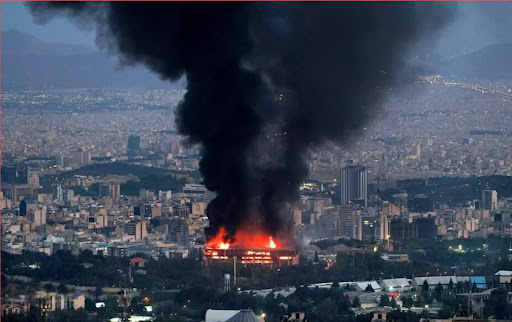
US Defence Secretary Pete Hegseth made sweeping claims on Saturday about the condition of Iran’s leadership, describing senior officials as “desperate and hiding” underground and suggesting that newly installed Supreme Leader Mojtaba Khamenei had been wounded and perhaps permanently disfigured. Iranian officials acknowledged Khamenei had been injured in an earlier Israeli strike but maintained his condition was not serious. The competing narratives highlighted the significant uncertainty surrounding events inside Iran as the US bombing campaign entered its third week.
Analysts cautioned against reading the leadership strikes as a sign that Iran was close to collapse. The International Crisis Group’s Iran expert, Ali Vaez, said the regime appeared “pretty intact” despite losing senior figures and was executing a deliberate strategy of survival, sustained retaliation, and prolonged conflict. Iran’s goal, Vaez argued, was to outlast American resolve and secure a deal on its own terms rather than capitulate under military pressure.
The military campaign was advancing on all fronts. US warplanes continued to strike Iran on Saturday following the dramatic bombing of Kharg Island on Friday. President Trump said in public statements the island had been effectively demolished and left open the possibility of more strikes. Iran launched ballistic missiles at the UAE, hitting near Fujairah and disrupting oil-loading operations. Iranian commanders threatened strikes on any Gulf facility with American ownership and called on Arab neighbours to expel US forces.
Trump made a high-profile appeal on social media for allied nations to send warships to the Strait of Hormuz, naming China, France, Japan, South Korea, and the UK. Observers noted this was the first time Trump had publicly indicated the US might not be able to force the strait open alone. The waterway normally carries around 20 percent of global oil and gas and had been closed since Iran shut it when fighting began on February 28. Energy prices were already at elevated levels and threatening to rise further.
The human cost of the conflict was staggering. Between 1,400 and 1,800 people had been reported dead in Iran. Thirteen Israelis had died, and about 20 across the Gulf. More than 800 people had been killed in Lebanon amid Israeli strikes on Hezbollah, with 850,000 displaced. The US embassy in Baghdad was struck overnight, and Americans were ordered to leave Iraq. Six US troops died when a military aircraft crashed in western Iraq. Trump declined to provide any end date for the conflict, a position that left markets and governments worldwide increasingly anxious.