
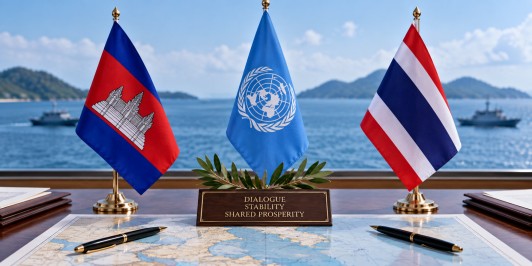
Cambodia and Thailand have embarked on a United Nations-supported conciliation process to address a protracted maritime boundary dispute in the Gulf of Thailand. This significant development involves both nations’ foreign ministers, who recently delivered opening remarks at the inaugural meeting under the United Nations Convention on the Law of the Sea (UNCLOS). The move aims to bring resolution to a conflict that has persisted for over a quarter of a century, impacting an area believed to hold substantial reserves of natural gas and oil.
In pursuit of a solution, Cambodia is advocating for the establishment of a singular maritime boundary with Thailand. Alternatively, Cambodia has expressed willingness to consider a joint development arrangement, enabling both countries to share the resources in the contested zone. On the other hand, Thailand has emphasized that the discussions should be strictly centered on maritime boundary delimitation. While Bangkok had previously suggested direct negotiations as a means to resolve the issue, it has now pledged to engage in the UN-backed process with sincerity.
The disputed maritime region, encompassing approximately 26,000 square kilometers, has been a point of contention due to its potential economic benefits. This has prompted both countries to seek a diplomatic resolution to harness the area’s resources effectively. In 2001, an agreement was reached to create a framework for the joint development of these resources. However, this arrangement was terminated by Thailand in May following heightened tensions arising from lethal border clashes between the two nations.
Initiating the compulsory UNCLOS conciliation process in June, Cambodia took steps to address the stalemate. The independent panel overseeing this process is tasked with issuing recommendations to facilitate resolution. Although the panel’s findings will not be legally binding, they could play a crucial role in guiding both countries toward a mutually agreeable solution.