
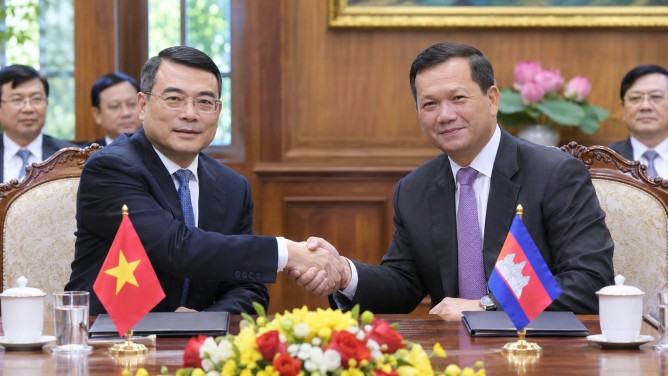
Vietnam and Cambodia are set to deepen their bilateral cooperation and expand economic ties following a recent agreement between Vietnamese Prime Minister Lê Minh Hưng and Cambodian Prime Minister Hun Manet. Meeting in Hanoi on Saturday, the two leaders outlined plans to enhance existing partnership mechanisms and boost collaboration across a variety of sectors.
The agreement comes ahead of the 12th Cambodia–Laos–Myanmar–Vietnam (CLMV) Summit and the 11th Ayeyawady–Chao Phraya–Mekong Economic Cooperation Strategy (ACMECS) Summit. Both prime ministers emphasized the importance of maintaining strong political trust and mutual respect as they aim to bolster ties in defense, security, trade, investment, tourism, education, and infrastructure development.
A key focus will be on improving the effectiveness of bilateral cooperation mechanisms and ensuring that existing agreements yield practical results. Defense and security remain top priorities, with both leaders pledging to combat cross-border crimes such as drug trafficking, human trafficking, and online fraud. They also committed to preventing hostile groups from using either country’s territory to threaten the other’s security.
Economically, Vietnam and Cambodia are seeking to expand cross-border trade and enhance investment opportunities, with a shared goal to increase bilateral trade to US$20 billion in the near future. Discussions also included improving transport connectivity, upgrading border infrastructure, and expanding logistics services. Areas like agriculture, energy, science and technology, and digital transformation were identified for future cooperation.
Additionally, the two countries plan to reinforce collaboration in education, vocational training, tourism, cultural exchanges, and human resource development, with a particular emphasis on engaging younger generations. Looking forward to the 60th anniversary of diplomatic relations in 2027, they will organize joint activities under the Vietnam–Cambodia Friendship Year to further strengthen public understanding and promote their longstanding relationship.
The leaders also agreed to maintain close coordination within ASEAN, the United Nations, and Mekong cooperation frameworks, underscoring their commitment to regional unity, stability, and respect for international law.