
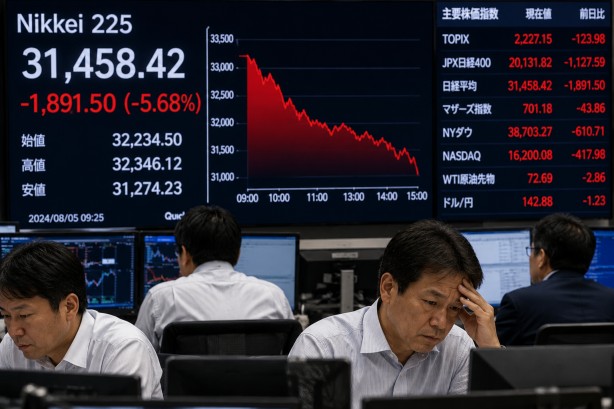
Asian stock markets experienced a significant downturn on Friday, with Japan’s Nikkei 225 index leading the decline due to substantial sell-offs in technology and artificial intelligence-related stocks, causing investor unease. The Nikkei fell 5.8%, closing below the 63,000 threshold. Taiwan’s market also suffered a loss exceeding 5%, while Hong Kong’s Hang Seng index decreased by 2%, and China’s Shanghai Composite was down 1.6%. Australia’s S&P/ASX 200 saw a smaller decline of 0.7%.
The recent pressures on technology stocks have intensified as concerns grow over the rapid increase in valuations within the artificial intelligence sector. Investors are increasingly skeptical about whether the demand for advanced chips and memory products will remain robust if artificial intelligence does not produce the anticipated profits and productivity enhancements. This skepticism is causing ripples across global markets.
In the United States, the technology-heavy Nasdaq Composite saw a 1.5% drop on Thursday, driven by losses among major chipmakers. Notably, Nvidia’s shares fell 2.4%, with other significant declines observed in companies like Micron Technology, SanDisk, and Western Digital. The impact on these stocks reflects the broader uncertainty surrounding the tech industry’s future growth prospects.
Amid these market challenges, oil prices have been on the rise, fueled by escalating tensions in the Middle East, which have sparked worries about potential disruptions to global energy supplies through the strategic Strait of Hormuz. Brent crude futures increased by 1.1% to reach $85.13 per barrel, while the US benchmark crude rose 1.3%, hitting $79.95 per barrel. These developments in the oil sector highlight the complex interplay of geopolitical factors and market dynamics affecting global economic stability.